2015

Sir Walter …

Raleigh or Scott or … buffalo grass.

Yates J has upheld the Registrar’s refusal to register SIR WALTER for buffalo grass in class 31 on the grounds it lacked any capacity to distinguish and was not in fact distinctive.[1]

Buchanan Turf has a PBR for a variety of soft leaf buffalo grass called Sir Walter – PBR Certificate No. 1082. The variety is actually registered as “Sir Walter”. The PBR is due to expire on 27 March 2018. After that date, of course, anyone will be free to propagate and sell the Sir Walter variety. I wonder what they will call it?

For reasons best known to themselves, Buchanan Turf sought to amend the class 31 specification during the examination process to read:

Buffalo grass of the ‘Sir Walter’ variety (as lodged with the Registrar of Plant Breeder’s Rights (ref: certificate no. 1028), being part of the genus Stenotaphrum and a member of the species Secundatum.

Are you still wondering what the putative propagaters after March 2018 will be wanting to call their variety of lawn seed?

Applying the usual tests, Yates J found that Sir Walter had no inherent capacity to distinguish:

Here, the appellant developed a new thing—a new variety of buffalo grass having particular characteristics—which it called Sir Walter. Sir Walter is the given and proper name for the new variety. It has no other name. In this way, the name Sir Walter must be taken to be part of the common stock of language that denotes this particular variety of grass.

His Honour distinguished the Zima case on the basis that “Zima” was not the name of a variety of tomato.

Buchanan Turf argued its name had acquired distinctiveness – there had been over $16 million in sales since 1996 and some 68 licensed growers. There was also evidence of extensive television, radio and other media advertising; often featuring the terms Sir Walter in combination with a knight device,[2] almost invariably presenting the expression in quotes. One example of use without the device by way of illustration:

“Sir Walter” Premium lawn turf

Sir Walter Premium Lawn Turf is a superior quality soft buffalo grass giving unmatched performance for Australian conditions. Here you can find out all there is to know about this ideal, low maintenance lawn called ‘Sir Walter’. ….

His Honour considered that these types of use, even in specially marked out form, just identified the type of grass that was being used. In doing so, Yates J pointed out that just because the public had come to associate a term with a particular trader did not mean in functioned as a trade mark, relying on Jacob LJ’s dictum in the British Sugar case[3] and BP v Woolworths.

Where the name was used with the knight device, it was not sufficient to show that the combined device as a whole was distinctive, or had acquired distinctiveness. It was necessary to show that SIR WALTER alone had done so as the knight device was not part of the trade mark applied for. As with the standalone uses, in context the name just referred to the type of grass, not its trade source.

Yates J noted that there was no direct evidence from customers about what the name signified to them. This seems to be a recurrent theme in judicial comment. I wonder, however, what that evidence would need to disclose before the conclusion that any such customers just associated the name with Buchanan Turf could be overcome especially in circumstances where (a) it was the name of the variety and (b), until March 2018, there can be only one trade source?[4]

The PBR Act provides:[5]

A name … in respect of a plant variety must not:

(e) be or include a trade mark that is registered, or whose registration is being sought, under the Trade Marks Act 1995 , in respect of live plants, plant cells and plant tissues.

Yates J thought this provision evidenced a policy that rights to use a plant variety name after the PBR had expired should not be impeded by a trade mark registration which, of course, May last a lot longer than a PBR. However, there was no express prohibition in the Trade Marks Act, as there is with the names of patented things, against registering the name of a PBR as a trade mark.

Buchanan Turf Supplies Pty Ltd v Registrar of Trade Marks [2015] FCA 756


  1. Trade Marks Act 1995 s 41(6) (i.e., the old form).  ?
  2. One representation of the combination mark is shown in the Schedule. The knight device is itself a registered trade mark, No 882781.  ?
  3. TREAT: the relevant extract is set out at paragraph 34.  ?
  4. For one case where consumer type evidence was successfully led, see Philmac v Registrar of Trade Marks.  ?
  5. Plant Breeders Act 1994 s 27(5)  ?

Sir Walter … Read More »

Are innovation patents going?

Last year, ACIP ducked the question of keeping or abolishing the controversial innovation patent system. Last week, ACIP issued an “updated” statement in which it recommended abolition of the innovation patent system.

What happened?

According to ACIP, in the intervening period, IP Australia’s Chief Economist took advantage of data that became available through the Government’s Intellectual Property Government Open Data (IPGOD) “to undertake a comprehensive analysis of the economic impact of the innovation patent system”. That study disclosed:

The great majority of Australian SMEs and private inventors appear to gain little benefit from the system… Only 23 SMEs have become moderate users of the innovation patent system … The average SME or private inventor files once and never again (74%), does not receive any enforceable right (83%) and lets their patent expire early because they see its value at less than the $110-$220 cost of renewal (78%).

Further

While 94% of innovation patent applications are made by private inventors or SMEs and they incur 95% of the regulatory costs of the system, larger firms who are already well served by the standard patent system tend to reap a disproportionate share of the benefits.

Taking into account regulatory costs and costs to public welfare generally, ACIP considers that the costs of the innovation system outweigh the benefits and so recommends abolition.

ACIP Review of the Innovation Patent System: Final Report May 2015 (updated to include new statement) (pdf)

The Statement

At the time of writing, the link to the comprehensive analysis of the economic data does not appear to be working.

Dr Summerfield takes a different view.

Are innovation patents going? Read More »

Of flat nosed syringes or if at first you don’t succeed

Having had the interlocutory injunction he granted overturned on appeal, Rares J has now determined at the substantive trial that both of Glaxo’s syringe variants infringed Reckitt Benkiser’s “flat-nosed syringe” patent.

You will recall that Reckitt has patented a bottle and syringe combination to simplify “feeding” medicines to babies and toddlers in particular. Claim 1 in part provides:

A liquid dispensing apparatus comprising a bottle, a bottle neck liner and a flat-nosed syringe having a plunger and a barrel, the barrel terminating at its distal end in a generally flat face having a diameter corresponding to the diameter of the syringe barrel and being perpendicular to the longitudinal axis of the barrel ….

… the claim goes on at some length to elaborate in further detail the features of the various elements.

Glaxo had two variants of its competing product:

Glaxo Version 1
Glaxo Version 1
Glaxo Version 2
Glaxo Version 2

For present purposes, I found two points of interest: the finding that the second variant infringed and the failure of Glaxo’s entitlement attack.

Infringement

After dealing with construction issues at some length, Rares J found the first version infringed claim 1, but Glaxo’s second version did not. This was because, at [126], the indented “tip” at the distal (bottom) end of the syringe meant the end was not substantially the same diameter as the barrel itself.

Notwithstanding this, Rares J found the second version did infringe claim 9, the omnibus claim:

  1. A liquid dispensing apparatus, substantially as described with reference to the drawings and/or examples.

Rares J considered that the second variant functioned the same as the preferred embodiment described in the specification and drawing. While the indented tip was a difference, claim 9 required only substantial compliance and there was no difference in substance between the second variant and the patent description. At [149], his Honour explained:

…. The alternate syringe has exactly the same function as that described in the patent and the drawings. The alternate syringe is a flat-nosed syringe that has a distal end that fits into the liner and achieves a good seal with it so that it can draw up liquid without leaking from the bottle or the syringe. The mere fact that there is a corresponding tip on both the barrel and the reciprocating plunger used in the alternate syringe in the second product complained of should not be allowed to disguise that that product has taken the substantial configuration resulting from the patentee’s invention and its character for the dispensing of liquids from bottles without mess using an apparatus with a flat-nosed syringe: Radiation 60 CLR at 52; Raleigh 65 RPC at 160. The alternate syringe, as incorporated into the second product complained of, is not a substantially new or different combination ….

Earlier, his Honour had pointed out that the bottle liner of Glaxo’s second variant was shaped to complement the configuration of the indented tip of the syringe to sealingly engage as required by the patent. Although liquid was drawn into the indented tip from the bottle, it was essentially “dead space” as the tip of the syringe’s plunger had a correspondingly indented end so that the barrel measured volumes in the same as as the patented description. Accordingly at [150]:

The alternate syringe takes the substance of the flat-nosed syringe described in the patent and drawings as stated in claim 9.

Entitlement

In coming up with the claimed apparatus, Reckitt[1] had engaged a contractor. Glaxo argued that it was the contractor’s operative, a Mr Pearce, who was actually the inventor. Even though Reckitt’s posited inventors did not give evidence, Rares J rejected this attack without needing to resort to s 22A or s 138(4).

Glaxo’s challenge essentially ran into two problems. First, when the contractor discovered the early version of the patent application leading to the patent, it did challenge Reckitt about it. It’s concern, however, was to ensure its continued ability to use the “liner” element, only one integer of the claimed invention as a whole. Arising from this, Reckitt did make some modifications to its application and the contractor reached agreement with Reckitt preserving the contractor’s ability to use features of the liner for other projects freely.

Secondly, although Mr Pearce did give evidence, it was limited to claiming inventive contribution only to the liner element and it was not suggested to him that he, rather than Reckitt’s employees, came up with the idea for the features of the other elements comprising the invention.

Glaxo’s claim based on false suggestion similarly failed:

the documentary evidence suggests that the idea that conceived of a combination of a flat-nosed syringe co-operating with a bottle neck liner and a bottle in the form of the apparatus had nothing to do with Mr Pearce or HDB and was Ms Dallison’s inspiration. She also had envisaged the features of that combination, being the way in which the flat-nosed syringe would co-operate with the liner, and, with Mr Harrison, the need for the liner to be adapted suitably to pour, without mess, the liquid contents from the bottle ….

Reckitt Benckiser Healthcare (UK) Ltd v Glaxosmithkline Australia Pty Ltd (No 5) [2015] FCA 486


  1. The named inventors were actually employees of Boots, the pharmacy chain, and Reckitt’s predecessor in title.  ?

Of flat nosed syringes or if at first you don’t succeed Read More »

Interlocutory Injunction to transfer domain name

Nicholas J has granted Thomas International an interlocutory injunction ordering Humantech to transfer the domain names, thomasinternational.com.au and thomas.co.za, to Thomas International. Thomas International had to give the usual undertakings and, as a foreign corporation, provide security for costs.

Thomas International is an English company which provides psychological testing and psychometric assessments, and competency and skills-based assessments, particularly using computerised services accessed over the internet through thomasinternational.net. It also makes its materials and services available through distributors. It appointed Humantech, a company associated with a Mr Schutte, as its master distributor/licensee for South Africa and Australia with power to exercise its rights through distributors. Humantech was permitted to use the “Thomas” trade marks, to incorporate a company in Australia under the name Thomas International (Australia) and to register the domain names. There were also obligations when the arrangements ceased or were terminated to cease use of the trade marks and change the corporate name of Thomas International (Australia) to a name which did not include Thomas.

In due course, the Schutte interests also incorporated another entity, ACT, which offered similar services to Thomas International’s assessment and training services. Thomas International alleges that, after some successful years’ trading, revenues from Thomas International (Australia) starting dropping off and the Schutte interests were diverting customers to ACT which, without permission, was using materials based on Thomas International’s materials.

Thomas International sued Humantech, Thomas International (Australia), ACT and Mr Schutte. There was a meeting between the parties and their lawyers shortly after. Thomas International said it would not discuss a new licensing arrangement until an undertaking dealing with the existing issues was provided. As a result, Humantech and the Schutte interests provided an undertaking to cease use of Thomas International’s trade marks, intellectual property and to transfer the domain names over. Thomas International also agreed to negotiate about a new licensing arrangement in good faith.

The next day Thomas International made its licence proposal to the Schutte interests. They considered it was financially unworkable and left the meeting. Later that day, they then put Humantech (and subsequently the other corporate entities) into administration and disabled the website. Shortly thereafter, Thomas International applied for interlocutory injunctions.

As noted, Nicholas J granted the interlocutory injunctions including an order that the domain names be transferred to Thomas International. The terms of the Undertaking meant it had a prima facie case to force the Schutte interests to stop using the Thomas name and trade mark and for the transfer of the domain names.

The Schutte interests’ main attempt to rebut that was their argument that the Undertaking was invalid or unenforceable. That was said to result because, it was alleged, that Thomas International extracted the Undertaking in return for its promise to negotiate a new licence arrangement in good faith. The Schutte interests contended that the terms of the licence they were offered were so unreasonable as to show that Thomas International did not negotiate, and had no intention of negotiating, in good faith. This issue was not developed in detail at this stage, but Nicholas J pointed out that, on the current state of the law in Australia, an obligation to negotiate in good faith did not require a party to subordinate its own interests to that of the other party.

On the balance of convenience, Nicholas J accepted Thomas International’s argument that:

the present state of affairs may cause TIL significant reputational damage as a result of customers who have purchased units entitling them to make use of facilities provided by TIL at the Thomas Hub being prevented from gaining access to it through the TIA website. I accept this submission. I also consider that any such damage may be irreparable and that damages will most likely not provide an adequate remedy. The financial statements of TIA for the financial year ending 30 June 2014 show that the company has net assets of just under $145,000.

On the other hand, the Schutte interests’ main argument was the disruption to their business, and that of their customers, if they could not continue to use the domain names, the main access point for provision of services both to Thomas International (Australia)’s customers and those ACT. As Nicholas J pointed out, however, the Schutte parties had already disabled access to the websites so they had already caused that problem themselves.

It would appear that Thomas International first learned something about ACT’s activities, the subject of the complaint, in May 2014 (i.e., a year earlier). However, Thomas International was able to lead evidence showing all the work it did, and the difficulties it encounted, in trying to ascertain what ACT was doing until proceedings were issued. In this context, the termination by Humantech of the main employee with responsibilities for running the Thomas part of its business may will have been highly significant.

Permission to proceed against the companies although administrators were appointed was granted as the interests of the administrators were adequately protected by the undertaking as to damages and provision for securities.

Thomas International Limited v Humantech Pty Ltd [2015] FCA 541

Interlocutory Injunction to transfer domain name Read More »

What constitutes authorised use of a trade mark?

In the latest round of the worldwide war between Wild Turkey bourbon[1] and Wild Geese Irish whisky[2], Perram J has reluctantly found that actual control of the licensee is not necessary and potential control will suffice for authorised use[3] under the Trade Marks Act 1995.

Mr Sullivan QC, a barrister in South Australia, has a winery there under the name Wild Geese Wines. When he sought to register it as a trade mark, he discovered the war between Wild Turkey and Wild Geese Irish whisky. Deciding discretion was the better part of valor, in 2007 he sold his trade mark rights to Wild Turkey bourbon and received a perpetual, exclusive licence back for the princely sum of $1.00 plus he agreed to a number of quality control provisions:

  • his wine had to be of sufficient quality to obtain continuing export approval from the Australian Wine and Brandy Corporation;
  • on request from the licensor, he had to supply up to 3 bottles of his wine to the licensor each year and, if the licensor required, supply 4 bottles to the Australian Wine and Brandy Corporation for testing;
  • if his wines did not meet the Australian Wine and Brandy Corporation’s requirements, the licensor could terminate the licence;
  • he was not allowed to use the trade mark outside Australia and he could use the trade mark only on Australian wine;
  • as is typcial, he was not allowed to use the trade mark in some altered or abbreviated form or in any scandalous fashion;
  • he also had to maintain insurance; and
  • he was not allowed to represent in any way that he was a licensee of Wild Turkey.

The main point of interest about these provisions is that Wild Turkey did not actually seek to exercise any of them until April 2011, that is, four years down the track. By this time, however, Lodestar Anhalt had filed its non-use action and so Wild Turkey had to show it had used its Wild Geese Wines trade mark as a trade mark in the period September 2007 to September 2010. Its only way to do so was in reliance on Mr Sullivan’s use as an authorised user.[4]

The Wine and Brandy Corporation conditions are interesting for at least 2 reasons. The first was that Mr Sullivan proposed them so that he was not at the mercy of the licensor’s potentially subjective whim about whether or not his wine was of an acceptable quality. Secondly, while Mr Sullivan had no idea what standard was required for export approval, apparently over 99% of wine submitted to the Australian Wine and Brandy Corporation qualified for export approval.

Perram J had no trouble finding that Wild Turkey had not exercised actual control over Mr Sullivan’s use of the Wild Geese Wines trade mark. The question was whether the potential for such control was enough.

First, Perram J considered that a trade mark licence under the 1955 Act would be valid only if control was actually exercised over the licensee.

Secondly, his Honour considered that what needed to be shown under the 1955 Act was a connection in the course of trade. This was different to what was required under s 17 of the 1995 Act and the requirements for authorised use under s 7 and s 8.[5]

Left to his own devices, Perram J considered that the requirements for authorised use still required that control actually be exercised over the licensee. However, his Honour considered he was bound by the Full Court’s decision in Yau Entertainment to find that the potential to exercise control was sufficent. As Wild Turkey had that potential through the terms of the licence agreement, Mr Sullivan’s use qualified as authorised use and so his sales under the trade mark in the relevant period, while small, were sufficient to defeat the non-use action.

If his Honour had found that potential control had not been sufficient, he would not have exercised a discretion against removal.

Skyy Spirits LLC v Lodestar Anstalt [2015] FCA 509


  1. For this round of the dispute owned by Skyy Spirits, part of the Campari group. Previously, the relevant entity had been Austin Nichols.  ?
  2. Still held by Lodestar Anhalt, a Lichtenstein corporation. More wild geese. ?
  3. Authorised use counts as use by the trade mark owner: s 7(3).  ?
  4. One can imagine that the impending removal action may have been the trigger for Wild Turkey’s “sudden” interest in exercising control. Things are perhaps not so clear as that: in fact, from 2007 to 2010, Mr Sullivan was only offering for sale a merlot he had bottled in 2004. It was not until 2010 that he bottled a pinot noir, which did not go on the market until later in 2011. The reported reasons do not indicate whether anyone on the Wild Turkey side ever tasted the merlot as part of the “licensing” process although, as Wild Turkey had the onus to rebut the non-use allegation, one might expect it would have to have led evidence to establish that – if it wished to rely on it.  ?
  5. On one view, paragraph 42 of the High Court’s Gallo decision tells us that the definition of “use as a trade mark” provided by s 17 of the 1995 Act means the same thing as the definition in s 6(1) of the 1955 Act, notwithstanding that s 17 no longer refers to “a connexion in the course of trade”.  ?

What constitutes authorised use of a trade mark? Read More »

Project home appeals

The Full Court has partially allowed Tamawood’s appeal, and denied Habitare’s appeal from Collier J’s findings about copyright infringement.

Tamawood designs and builds homes; Habitare is (or was) a developer. Habitare arranged for Tamawood to design some houses for a development it was working on. The plans were submitted to the local authority for, and received, planning approval. Tamawood and Habitare were unable to agree the basis on which they would go forward. Habitare decided to get Mondo Architects to draw up the building plans to carry the project forward and used Bloomer to build the houses. At first instance, Collier J found some of Mondo’s plans infringed, but others did not.

On appeal, the Full Court upheld Collier J’s ruling that Habitare’s licence to use the plans with planning approval terminated when Habitare decided not to proceed with Tamawood. This was because the basis of the licence was that Tamawood would not charge for preparing the drawings on the understanding it would build the houses. Use (ie., reproduction) of the plans outside those terms was unlicensed.

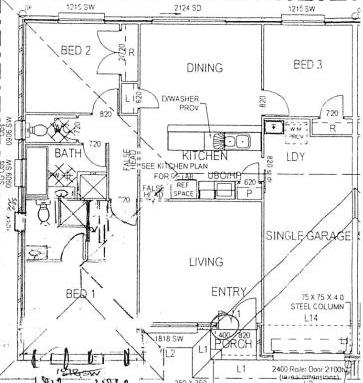
On appeal, Tamawood also successfully challenged Collier J’s conclusion that its copyright in “Stad 939 Conondale/Dunkeld”:

Stad 939 Conondale/Dunkeld

was not infringed by Mondo Duplex 1:

Mondo 1 Duplex with patio

Two points of interest here. First, the Full Court was unanimous in holding that Collier J had erred by ascertaining whether Mondo Duplex 1 sufficiently resembled Stad 939 Conondale/Dunkeld and then considering whether or not there had been copying. The question of copying needs to be resolved first although, in doing so, the degree of resemblance may lead to an inference of copying.

Secondly, for Jagot and Murphy JJ, the degree of resemblance, Mondo’s access to Tamawood’s plans and the significant difference between Mondo’s plans before that access and after all contributed to a conclusion of copying. Their Honour’s then applied Eagle Homes v Austec to find reproduction of a substantial part on the basis that the copyright work could still be seen in the accused plans. For Jagot and Murphy J the changes in the floor plan were minor. At [168]:

The footprints of the duplexes are identical but for the addition of the patio at the rear of the Mondo Duplex 1 plans. The internal and other external differences all result from two changes – swapping the position of bedroom 1 with bedroom 2 and swapping the position of bedroom 3 with the living/entry space. All changes appear consequential on these two basic changes in location. The changes, however, are minor, in the sense that the overall relationship between the internal spaces and the exterior remain the same. ….

Greenwood J dissented on this point at [89] – [90], considering that the layout and traffic flows, shapes and proportions and relationships of the rooms and other spaces were sufficiently different. His Honour considered that the common placement of Beds 1 and 2 and associated wet areas along the external walls of the duplex rather than the party wall was rational and for obvious reason.

Otherwise, the Full Court affirmed her Honour’s ruling at first instance.

Tamawood Limited v Habitare Developments Pty Ltd (Administrators Appointed) (Receivers and Managers Appointed) [2015] FCAFC 65


Project home appeals Read More »

How much is that copyright in the power generation system

The Full Federal Court has allowed the Commissioner of Taxation’s appeal from Pagone J’s ruling allowing SPI Powernet a deduction for the value of its copyright in the plans, drawings and manuals for its electricity power generation network.[1]

SPI Powernet bought the assets of the Victorian electricity power generation and transmission line system when the Kennett government privatised the State Electricity Commission in 1997. It paid $2.5 billion. The assets included the intellectual property rights which included the copyright in some 100,000 drawings and plans which were critical to the operation and maintenance of the business and various manuals and software.

The purchase price was not apportioned amongst the various assets. Indeed the sale agreement specified that the purchase price was fixed notwithstanding that the components might be shown “collectively to have a different value.”

SPI Powernet sought to apportion the purchase price among the various asset classes and, in the case of the copyright, claimed depreciation in respect of a “unit of industrial property”. The Commissioner assessed the value of the copyright at “nil”. Pagone J allowed SPI Powernet’s appeal, finding that the value of the copyright was in the order of $171 million using the replacement cost methodology.[2]

The Full Court’s decision involves a number of procedural issues as well as substantive questions including the extent to which the Commissioner’s methodology could be challenged and his Honour’s exclusion of the expert’s written reports at first instance.[3]

The Full Court were agreed that the valuation exercise undertaken by the experts was misdirected. The question was what part of the purchase price should be attributed to the copyright, not what was the market value of the copyright. That caused two problems for the SPI Powernet parties.

One problem was the form of the purchase price: by specifying that it was a fixed price regardless of the value of the component assets, it meant that no cost could be attributed to a particular component. If you are drafting a sale agreement and including intellectual property rights in the assets and not apportioning the purchase price, be careful.

The second problem was that SPI Powernet, as the purchaser of all the assets to run a power generation business, would have a licence implied by necessity to use and reproduce the copyright in conjunction with the business. So, Greenwood J said at [185] and [186]:

…. Let it be assumed that SPI PowerNet had not acquired the copyright subsisting in the 105,410 documents. Could it be reasonably inferred in such a case, having regard to the terms of the Agreement under which SPI PowerNet acquired all of the relevant assets necessary to conduct the electricity transmission undertaking, that Power Net Victoria (the Victorian government owned corporation which formerly owned the copyright in the documents), would have been the source of an implied licence in favour of SPI PowerNet to use all of the documents in connection with that undertaking in a way which included exercising any and all rights falling within the rights comprised in the copyright? The answer to that question seems plainly enough yes, in which event any exercise of any of the rights subsisting in the copyright would have occurred with the licence of the owner of the copyright.

Fourth, in those circumstances, it is not necessary to undertake a timebased analysis of the value of work which would have been necessary to recreate the 105,410 documents in a way which could have expressed the information contained in those documents in a noninfringing form. Such a valuation exercise does not aid or inform the statutory task under s 124R(5). I respectfully disagree with the finding of the primary judge at [33] that had the copyright not been acquired, SPI PowerNet would have had to create the field of documents in which copyright subsisted in a way which conveyed the same information but in a noninfringing way to enable the business to function.

and Edmonds J said at [102]:

If an actual acquisition by SPANT of all of SPI PowerNet’s assets as at 19 October 2005 had not included the copyright, there can be no doubt that by reason of the notion of “necessity”, as explained by McHugh and Gummow JJ in [Byrne v Australian Airlines Limited][byrne] (1995) 185 CLR 410 at 450, SPANT would have enjoyed an implied licence to copy and modify the drawings and documents in any event: see Copyright Agency Limited v State of New South Wales [2008] HCA 35; (2008) 233 CLR 279 at 305–306 [92] per Gleeson CJ, Gummow, Heydon, Crennan and Kiefel JJ, and the other cases there cited (also [81], [82] and the cases cited); see too Acohs Pty Ltd v Ucorp Pty Ltd and Anor [2012] FCAFC 16; (2012) 201 FCR 173 at [145].

Commissioner of Taxation v AusNet Transmission Group Pty Ltd [2015] FCAFC 60 (Kenny, Edmonds and Greenwood JJ)


  1. The case before the courts was actually 2 cases: 1 concerning SPI Powernet’s claim for the depreciation; the second by its parent when the parent adopted consolidated group accounts including SPI Powernet.  ?
  2. The valuation experts agreed there were three accepted methods to value the copyright: an income approach, a market value approach and a cost approach. Because there was nothing income generated from exploiting the copyright nor a market for the copyright, SPI Powernet’s experts applied the “replacement cost” method – what it would cost in time and effort to recreate the drawings etc. from scratch. See e.g. Pagone J at [24].  ?
  3. The latter of which led to the Full Court quashing his Honour’s decision on that part of the case and remitting it for reconsideration by Pagone J on the basis at [85] and [101] that the exclusion of the written reports meant it was impossible for the Full Court to evaluate his Honour’s reasons for accepting the views of SPI Powernet’s experts over the Commssioner’s expert on what all parties considered the fundamental issuel  ?

How much is that copyright in the power generation system Read More »

ACIP Final Designs Report

ACIP’s final report into its review of the Designs System has been published.

The report is 70 pages (including annexes) – 43 pages for the report itself; and 23 recommendations. Key recommendations include:

  • investigate joining the Hague system and, if a decision is made to join, extend the maximum term of design protection to 15 years;
  • introduce a grace period of 6 months before the filing date, but require an applicant relying on it to file a declaration to that effect;
  • rename a registered design that has not been certified as an “uncertified design”;
  • require a registered design owner to request examination by the first renewal deadline (i.e. 5 years);
  • introduce a system of opposition following certification;
  • improve the process for multiple designs by reducing fees in line with the ALRC’s original proposal;
  • allow fiddling with the statement of newness and distinctiveness until certification;
  • fix up a range of anomalies;
  • specifically include the role of the designs system in any broader review of Australia’s IP framework such as that contemplated by the Competition Policy Review;
  • not introducing an unregistered design right.

ACIP Final Designs Report Read More »

Commonwealth seeks $60 million on the undertaking as to damages

Sanofi sued Apotex (then known as GenRx) for infringement of its “clopidogrel patent”. It obtained interlocutory injunctions against Apotex against the sale of Apotex’ product and preventing Apotex from applying to list its product under the Pharmaceutical Benefits scheme (PBS). As a condition of the grant of those interlocutory injunctions, Sanofi gave the “usual undertaking as to damages”:

“(a)          submit to such order (if any) as the Court may consider to be just for the payment of compensation, to be assessed by the Court or as it may direct, to any person whether or not a party, adversely affected by the operation of the interlocutory injunction or any continuation (with or without variation); and

“(b)          pay the compensation referred to in subpara (a) to the person or persons there referred to.”

Sanofi won at trial, but lost on appeal with the Full Court ordering its patent be revoked. Sanofi’s application for special leave to appeal to the High Court was refused on 12 March 2010.

Apotex sought compensation under the undertaking by motion in May 2010. Sanofi and Apotex resolved that application by negotiation.

The Commonwealth also sought compensation under the undertaking as to damages by application made in April 2013. If we did not know before, we now know the Commonwealth is seeking $60 million. Essentially, the Commonwealth contends that is how much less it would have had to pay out under the PBS if the interlocutory injunctions had not prevented Apotex applying to list its product under the PBS:


“The Commonwealth has provided some particulars of its damages. It alleges it has suffered financial loss in excess of $60 million as a result of Apotex being prevented by the various interlocutory orders and undertakings from achieving a listing for its clopidogrel products under the PBS. Most of the Commonwealth’s loss is said to flow from statutory price reductions and price disclosure reductions that would have occurred had Apotex not been the subject of the relevant interlocutory restraints.”


The case is a long way off resolution. Nicholas J has allowed Sanofi to amend its points of defence to the Commonwealth’s claim to rely on the Commonwealth’s delay in making its application for compensation and to rely on infringement of copyright in Sanofi’s product information documents. Sanofi will be required to particularise the prejudice its claims it suffered as a result of the delay.

Nicholas J however refused leave to amend to plead that the Full Court’s decision invalidating Sanofi’s patent was wrong in light of the Full Bench’s subsequent decision in AstraZeneca (rosuvastatin). That would be inconsistent with res judicata and the principle of finality of litigation.

Commonwealth of Australia v Sanofi-Aventis [2015] FCA 384

Commonwealth seeks $60 million on the undertaking as to damages Read More »

Australian Intellectual Property Report 2015

IP Australia has released its Australian Intellectual Property Report 2015.

In addition to reporting on a range of statistics and some commentary, the report includes a number of “interactive” graphs that you may explore. Much, if not all, of the data is available through the Government Open Data initiative.

The headline point is that applications for trade marks and plant breeder’s rights increased over 2013, while applications for patents and registered designs decreased. The report attributes the decline in patent applications to the increased threshold arising from the commencement of most of the substantive reforms in the Raising the Bar and the rush to file before their commencement.

Australians are the largest source of filings for trade mark, registered designs and pbr. US-based applicants the largest source of patent applications; Australian residents being the second largest.

There were 25,947 applications for standard patents in 2014, a decrease of 13% on 2013. 19,034 standard patents were granted; an increase of 13% over 2013. Over 94% were granted to non-residents. The average number of months from filing to request for examination fell from 16.3 to 13.6 months; the average time from request to first report is just over 9 month and, on average, the time from first examination report to acceptance was a further 14 months. Australians filed 9,012 patent applications abroad in 2013 (41% in the USA), up 3% on 2012.

There were 1523 applications for innovation patents, down from 1676 in 2013. Australians accounted for 66% of the filings.

There were 64,381 trade mark applications filed in Australia in 2014, up 2% from 2013; correspondingly, Australians filed 16,267 applications overseas (in 2013). The top 3 filing destinations were the USA, China and NZ – accounting for 50%. The USA supplanted China as the “top destination”. Apparently, this is in line with a global trend.

6550 designs were registered in 2014, and 1452 were certified – almost double the number certified in 2013. IP Australia speculates that there are few applications to register designs because:

According to Lim et al (2014) the role of IP rights in the market for designs is limited.9 Buyers and sellers in the market view designs as a service that is co-created. As IP rights protect the artefact, not the service, IP rights are perceived as a secondary issue in the marketplace. This view of design rights provides insights into the low volume of design registrations relative to patents and trade marks.

The number of applications for plant breeder’s rights skyrocketed from 330 in 2013 to 341!

The report notes that IP Australia is aiming in 2015 to complete research projects into innovation trends in the mining industry, who and in which areas in the textile, clothing and footwear industry is filing patents and the role of geographical indicators.

Australian Intellectual Property Report 2015 Read More »

Scroll to Top