Australia

AstraZeneca goes down

The High Court has unanimously dismissed AstaZeneca’s appeal from the finding that its low dose patent for rosuvastatin was invalid as obvious. The main issue was whether the Courts below had impermissibly allowed one or other prior publication to be “added” to common general knowledge under the then narrow version of section 7(3). This was unanimously rejected.

AstraZeneca AB v Apotex Pty Ltd [2015] HCA 30.

AstraZeneca goes down Read More »

Abilify interlocutory injunction continues pending appeal

Last month, Yates J found that Otsuka’s patent for aripiprazole was invalid.[1] As a consequence, his Honour ordered that the interlocutory injunction preventing Generic Health from listing its product on the PBS and selling it be dissolved. Otsuka has appealed and now Nicholas J has granted a stay to preserve the interlocutory injunction pending the appeal.

While not being prepared to characterise Otsuka’s prospects on the appeal as higher than arguable, Nicholas J considered the balance of convenience favoured continuation of the interlocutory injunction.

Otsuka relied principally on the fact that there would be an automatic reduction of 16% the price payable under the PBS for Abilify[2] once Generic Health’s product was listed. It contended that it would not be possible to recover that price drop if its appeal were successful.

Generic Health countered that it risked losing the benefits of first mover advantage if it were enjoined and other generic producers were not. Generic Health’s evidence was that pharmacists would usually only carry one generic brand of each drug and that was likely to be the first brand “in”. This would exacerbate the difficulties in calculating its losses. Nicholas J did not dismiss that argument, but Otsuka said it would be seeking interlocutory injunctions against any other generics who tried to enter the market pending the appeal. Nicholas J noted further that, if Otsuka failed in an injunction applications against a second or further generic, that would be a strong basis to terminate the stay.

The Commonwealth also sought a specific undertaking to pay damages from Otsuka as the price of the injunction. It argues it will suffer loss, in the form of the higher prices payable under the PBS, if Generic Health continues to be enjoined but the appeal ultimately fails.

Nicholas J noted that a case has been stated to the Full Court on whether the Commonwealth can indeed claim under the “usual undertaking as to damages”. Subject to the outcome of that case, his Honour considered the Commonwealth was sufficiently within the scope of the usual undertaking and so did not need a separate, specific undertaking.

Nicholas J increased the security for costs that Otsuka had to provide to Generic Health in the amount of an additional $8.7 million[3] and, in addition, required a security of $6 million separately to the Commonwealth. His Honour also noted that the Commonwealth could apply to extend that security if the appeal was not decied in the first half of 2016.[4]

Otsuka Pharmaceutical Co., Ltd v Generic Health Pty Ltd [2015] FCA 848


  1. Otsuka Pharmaceutical Co., Ltd v Generic Health Pty Ltd (No 4) [2015] FCA 634. Patentology looked at the ‘swiss claims’ aspects of his Honour’s decision.  ?
  2. The commercial name under which aripiprazole is marketed by Otsuka and its licensee.  ?
  3. Otsuka has already provided $6.5 million pursuant to the orders made by Yates J at first instance.  ?
  4. At [35], Nicholas J recored that the Commonwealth estimated its losses from the continuation of the interlocutory injunction would be $6 million over the next 12 months and $15 million over the next 18 months.  ?

Abilify interlocutory injunction continues pending appeal Read More »

Productivity Commission to review all IP laws

The Harper Review[1] recommended that the Government should direct the Productivity Commission to undertake an overarching review Australia’s IP laws.

The Treasurer and the Minister for Small Business have now announced that review.

According to the Harper Review:

an appropriate balance must be struck between encouraging widespread adoption of new productivity-enhancing techniques, processes and systems on the one hand, and fostering ideas and innovation on the other. Excessive IP protection can not only discourage adoption of new technologies but also stifle innovation.

Given the influence of Australia’s IP rights on facilitating (or inhibiting) innovation, competition and trade, the Panel believes the IP system should be designed to operate in the best interests of Australians.

The Panel therefore considers that Australia’s IP rights regime is a priority area for review. (emphasis supplied)

In reaching that view, the Harper Review flagged concern about entering into new treaties with extended IP protections.

The terms of reference state:

In undertaking the inquiry the Commission should:

  1. examine the effect of the scope and duration of protection afforded by Australia’s intellectual property system on:

    a. research and innovation, including freedom to build on existing innovation;

    b. access to and cost of goods and services; and competition, trade and investment.

  2. recommend changes to the current system that would improve the overall wellbeing of Australian society, which take account of Australia’s international trade obligations, including changes that would:

    a. encourage creativity, investment and new innovation by individuals, businesses and through collaboration while not unduly restricting access to technologies and creative works;

    b. allow access to an increased range of quality and value goods and services;

    c. provide greater certainty to individuals and businesses as to whether they are likely to infringe the intellectual property rights of others; and

    d. reduce the compliance and administrative costs associated with intellectual property rules.

Then follows a catalogue of 9 matters for the Commission to have regard to. These include the Government’s desire to retain appropriate incentives for innovation, the economy-wide and distributional consequences of recommendation and the Harper Review’s recommendations in relation to parallel imports.[2]

The Commission must report within 12 months.


  1. The Competition Policy Review, recommendation 6.  ?
  2. Rec. 13 and section 10.6 of the Competition Policy Review: i.e., repeal any remaining restrictions unless the benefits outweigh the costs and the objectives of the restrictions can only be achieved by restricting competition. Cue diatribe about “restricting competition” especially given the oft mouthed formula that IP rights rarely (if ever) restrict competition.  ?

Productivity Commission to review all IP laws Read More »

Program formats and copyright

Channel 7 has lost its bid to get an interlocutory injunction against Channel 9’s show Hotplate.

Channel 7 claimed Hotplate infringes Channel 7’s copyright in the dramatic works consisting of the combination and series of incidents, plot, images and sounds that make up My Kitchen Rules:

  1. MKR Series 1, Episode 1;
  2.  the whole of MKR Series 1;
  3.  the whole of MKR Series 5; and
  4.  the whole of MKR Series 6.

Nicholas J found that Channel 7 had a reasonably arguable case, but did not agree with Channel 7 that it was a strong prima facie case. Then, his Honour considered the balance of convenience weighed in Channel 9’s favour.

Prima facie case

Nicholas J thought this might well cause Channel 7 some difficulties. At [15] his Honour said:

There may be a difficulty in framing the case in this way.  My understanding of Seven’s case is that it claims copyright in the dramatic work that constitutes the format for the MKR television program which was first reduced to material form in Series 1, Episode 1 (see Seven’s outline of submissions para 11). If that is correct, then one would expect subsequent episodes of MKR merely to reproduce the dramatic work (ie. the format) first seen in Series 1, Episode 1.  The alternative approach involves treating every subsequent episode of MKR as an original dramatic work that has its own original format.  This seems inconsistent with the way in which Seven has argued its case.  In any event, it is not necessary to explore this issue in any detail for present purposes.  In due course Seven will need to explain precisely how it puts its case.

Channel 9 contended that many of the key elements of MyKitchen Rules were common place and unoriginal. The makers of Hotplate, Endemol, also pointed to a catalogue of what it said were very substantial differences between the 2 shows:

(a) The Hotplate is based on professional restaurateurs, and established restaurant businesses, whereas MKR involves amateur cooks in their kitchens.

(b) The restaurants and contestants for The Hotplate were selected because they were varied examples of different restaurant styles and the best characters, not because they are from a particular State (as is the case for MKR) – as a result, two restaurants are in Sydney, one is in Brisbane, one is in Perth, one is in Mandurah (in Western Australia) and one is in regional Victoria.

(c) The restaurant businesses featured in The Hotplate focus on different cuisines in order to show different cooking styles, including Italian, Japanese, French, seafood, modern Australian and Asian fusion.

(d) In Round 1 of The Hotplate, the contestants are required to cook meals from their existing menu, and must be prepared to cook anything on the menu since they are not given advance notice of which two entrees, two mains and two desserts will be ordered by the judges, whereas in MKR the contestants select their own menu of one entree, one main and one dessert. The Hotplate shows the contestants preparing meals, but does not show them shopping for ingredients as for MKR.

(e) When their restaurant is featured, the contestants in The Hotplate wear what they generally wear in their day-to-day business – they are not provided with a branded apron as they are for MKR or for Masterchef (another well-known cooking program).

(f) In Round 1 of The Hotplate, the other restauranteur contestants provide their scores to the judges in a bill folder, but in Round 2 (after the restaurant makeovers), the other contestants must deliver their scores directly to the contestants whose restaurant is being featured on the night.

(g) The judges in The Hotplate give feedback to the contestants about everything from the ambiance and decor of the restaurant to the service to the overall menu to the specific dishes they serve – this is aimed at assisting the restaurateurs with how they can improve their businesses as a whole, not just the cooking. This is not an element of MKR since the program does not involve actual restaurant businesses.

(h) In Round 2 of The Hotplate, the contestants are given an amount of money to undertake renovations and makeovers of their restaurant’s furniture, colour scheme and decor in addition to updating of the restaurant’s menu. Again, this is not an element of MKR since the program does not involve the renovation or makeover of restaurant businesses. This information may be confidential to Nine. I have not had time to check while preparing this affidavit.

(i) In Round 3 of The Hotplate, the contestants cook meals from their newly renovated restaurants for diners. This is not an element of the MKR program since it does not involve restaurants or their diners.

Balance of convenience

Nicholas J accepted that Channel 7’s losses would be difficult to quantify. His Honour considered, however, that Channel 9’s losses would also be particularly difficult to quantify. The factor which appears to have tipped the balance, bearing in mind the problematic strength of Channel 7’s claim that its rights were infringed, was the disruption to Channel 9’s broadcasting schedule. 3 episodes of Hotplate had already broadcast and it was unrealistic to expect Channel 9 could simply resume where it left off, or start over again, if it successfully defended the infringement claim. At [41] and [42], his Honour said:

During the course of argument it was suggested by Senior Counsel for Seven that if Nine was restrained from broadcasting further episodes of Hotplate, it would be able to resume broadcasting them at a later date on the assumption that no permanent injunction was granted. I doubt that this would be as simple as the submission seemed to suggest. Presumably it would be necessary for Nine to re-broadcast the first three or more episodes. I think it would be difficult for Nine to re-establish the program’s momentum after it was abruptly halted by injunction and then “shelved” for however many months it takes to determine the proceeding and any subsequent appeal.

There is evidence from Ms Officer to show that Nine considers Hotplate to be a key piece of its programming that Nine has decided to broadcast in prime-time slots not only with a view to achieving high ratings for Hotplate itself, but also with a view to boosting the ratings of some of Nine’s other programs.

Seven Network (Operations) Limited v Endemol Australia Pty Limited [2015] FCA 800

Program formats and copyright Read More »

Innovation patent consultation on the consultation

IP Australia has issued a consultation paper seeking the public’s view on (the now departed) ACIP’s recommendations for the innovation patent. Specifically:

IP Australia is seeking feedback from interested stakeholders on:

  • the ACIP recommendation that the government should consider abolishing the innovation patent system
  • any alternative suggestions to encourage innovation amongst SMEs.

Get your comments in by 25 September 2015

IP Australia’s consultation paper here (pdf or word). The ACIP report being “consultated” upon, via here and updated here.

Innovation patent consultation on the consultation Read More »

Sir Walter …

Raleigh or Scott or … buffalo grass.

Yates J has upheld the Registrar’s refusal to register SIR WALTER for buffalo grass in class 31 on the grounds it lacked any capacity to distinguish and was not in fact distinctive.[1]

Buchanan Turf has a PBR for a variety of soft leaf buffalo grass called Sir Walter – PBR Certificate No. 1082. The variety is actually registered as “Sir Walter”. The PBR is due to expire on 27 March 2018. After that date, of course, anyone will be free to propagate and sell the Sir Walter variety. I wonder what they will call it?

For reasons best known to themselves, Buchanan Turf sought to amend the class 31 specification during the examination process to read:

Buffalo grass of the ‘Sir Walter’ variety (as lodged with the Registrar of Plant Breeder’s Rights (ref: certificate no. 1028), being part of the genus Stenotaphrum and a member of the species Secundatum.

Are you still wondering what the putative propagaters after March 2018 will be wanting to call their variety of lawn seed?

Applying the usual tests, Yates J found that Sir Walter had no inherent capacity to distinguish:

Here, the appellant developed a new thing—a new variety of buffalo grass having particular characteristics—which it called Sir Walter. Sir Walter is the given and proper name for the new variety. It has no other name. In this way, the name Sir Walter must be taken to be part of the common stock of language that denotes this particular variety of grass.

His Honour distinguished the Zima case on the basis that “Zima” was not the name of a variety of tomato.

Buchanan Turf argued its name had acquired distinctiveness – there had been over $16 million in sales since 1996 and some 68 licensed growers. There was also evidence of extensive television, radio and other media advertising; often featuring the terms Sir Walter in combination with a knight device,[2] almost invariably presenting the expression in quotes. One example of use without the device by way of illustration:

“Sir Walter” Premium lawn turf

Sir Walter Premium Lawn Turf is a superior quality soft buffalo grass giving unmatched performance for Australian conditions. Here you can find out all there is to know about this ideal, low maintenance lawn called ‘Sir Walter’. ….

His Honour considered that these types of use, even in specially marked out form, just identified the type of grass that was being used. In doing so, Yates J pointed out that just because the public had come to associate a term with a particular trader did not mean in functioned as a trade mark, relying on Jacob LJ’s dictum in the British Sugar case[3] and BP v Woolworths.

Where the name was used with the knight device, it was not sufficient to show that the combined device as a whole was distinctive, or had acquired distinctiveness. It was necessary to show that SIR WALTER alone had done so as the knight device was not part of the trade mark applied for. As with the standalone uses, in context the name just referred to the type of grass, not its trade source.

Yates J noted that there was no direct evidence from customers about what the name signified to them. This seems to be a recurrent theme in judicial comment. I wonder, however, what that evidence would need to disclose before the conclusion that any such customers just associated the name with Buchanan Turf could be overcome especially in circumstances where (a) it was the name of the variety and (b), until March 2018, there can be only one trade source?[4]

The PBR Act provides:[5]

A name … in respect of a plant variety must not:

(e) be or include a trade mark that is registered, or whose registration is being sought, under the Trade Marks Act 1995 , in respect of live plants, plant cells and plant tissues.

Yates J thought this provision evidenced a policy that rights to use a plant variety name after the PBR had expired should not be impeded by a trade mark registration which, of course, May last a lot longer than a PBR. However, there was no express prohibition in the Trade Marks Act, as there is with the names of patented things, against registering the name of a PBR as a trade mark.

Buchanan Turf Supplies Pty Ltd v Registrar of Trade Marks [2015] FCA 756


  1. Trade Marks Act 1995 s 41(6) (i.e., the old form).  ?
  2. One representation of the combination mark is shown in the Schedule. The knight device is itself a registered trade mark, No 882781.  ?
  3. TREAT: the relevant extract is set out at paragraph 34.  ?
  4. For one case where consumer type evidence was successfully led, see Philmac v Registrar of Trade Marks.  ?
  5. Plant Breeders Act 1994 s 27(5)  ?

Sir Walter … Read More »

Are innovation patents going?

Last year, ACIP ducked the question of keeping or abolishing the controversial innovation patent system. Last week, ACIP issued an “updated” statement in which it recommended abolition of the innovation patent system.

What happened?

According to ACIP, in the intervening period, IP Australia’s Chief Economist took advantage of data that became available through the Government’s Intellectual Property Government Open Data (IPGOD) “to undertake a comprehensive analysis of the economic impact of the innovation patent system”. That study disclosed:

The great majority of Australian SMEs and private inventors appear to gain little benefit from the system… Only 23 SMEs have become moderate users of the innovation patent system … The average SME or private inventor files once and never again (74%), does not receive any enforceable right (83%) and lets their patent expire early because they see its value at less than the $110-$220 cost of renewal (78%).

Further

While 94% of innovation patent applications are made by private inventors or SMEs and they incur 95% of the regulatory costs of the system, larger firms who are already well served by the standard patent system tend to reap a disproportionate share of the benefits.

Taking into account regulatory costs and costs to public welfare generally, ACIP considers that the costs of the innovation system outweigh the benefits and so recommends abolition.

ACIP Review of the Innovation Patent System: Final Report May 2015 (updated to include new statement) (pdf)

The Statement

At the time of writing, the link to the comprehensive analysis of the economic data does not appear to be working.

Dr Summerfield takes a different view.

Are innovation patents going? Read More »

Of flat nosed syringes or if at first you don’t succeed

Having had the interlocutory injunction he granted overturned on appeal, Rares J has now determined at the substantive trial that both of Glaxo’s syringe variants infringed Reckitt Benkiser’s “flat-nosed syringe” patent.

You will recall that Reckitt has patented a bottle and syringe combination to simplify “feeding” medicines to babies and toddlers in particular. Claim 1 in part provides:

A liquid dispensing apparatus comprising a bottle, a bottle neck liner and a flat-nosed syringe having a plunger and a barrel, the barrel terminating at its distal end in a generally flat face having a diameter corresponding to the diameter of the syringe barrel and being perpendicular to the longitudinal axis of the barrel ….

… the claim goes on at some length to elaborate in further detail the features of the various elements.

Glaxo had two variants of its competing product:

Glaxo Version 1
Glaxo Version 1
Glaxo Version 2
Glaxo Version 2

For present purposes, I found two points of interest: the finding that the second variant infringed and the failure of Glaxo’s entitlement attack.

Infringement

After dealing with construction issues at some length, Rares J found the first version infringed claim 1, but Glaxo’s second version did not. This was because, at [126], the indented “tip” at the distal (bottom) end of the syringe meant the end was not substantially the same diameter as the barrel itself.

Notwithstanding this, Rares J found the second version did infringe claim 9, the omnibus claim:

  1. A liquid dispensing apparatus, substantially as described with reference to the drawings and/or examples.

Rares J considered that the second variant functioned the same as the preferred embodiment described in the specification and drawing. While the indented tip was a difference, claim 9 required only substantial compliance and there was no difference in substance between the second variant and the patent description. At [149], his Honour explained:

…. The alternate syringe has exactly the same function as that described in the patent and the drawings. The alternate syringe is a flat-nosed syringe that has a distal end that fits into the liner and achieves a good seal with it so that it can draw up liquid without leaking from the bottle or the syringe. The mere fact that there is a corresponding tip on both the barrel and the reciprocating plunger used in the alternate syringe in the second product complained of should not be allowed to disguise that that product has taken the substantial configuration resulting from the patentee’s invention and its character for the dispensing of liquids from bottles without mess using an apparatus with a flat-nosed syringe: Radiation 60 CLR at 52; Raleigh 65 RPC at 160. The alternate syringe, as incorporated into the second product complained of, is not a substantially new or different combination ….

Earlier, his Honour had pointed out that the bottle liner of Glaxo’s second variant was shaped to complement the configuration of the indented tip of the syringe to sealingly engage as required by the patent. Although liquid was drawn into the indented tip from the bottle, it was essentially “dead space” as the tip of the syringe’s plunger had a correspondingly indented end so that the barrel measured volumes in the same as as the patented description. Accordingly at [150]:

The alternate syringe takes the substance of the flat-nosed syringe described in the patent and drawings as stated in claim 9.

Entitlement

In coming up with the claimed apparatus, Reckitt[1] had engaged a contractor. Glaxo argued that it was the contractor’s operative, a Mr Pearce, who was actually the inventor. Even though Reckitt’s posited inventors did not give evidence, Rares J rejected this attack without needing to resort to s 22A or s 138(4).

Glaxo’s challenge essentially ran into two problems. First, when the contractor discovered the early version of the patent application leading to the patent, it did challenge Reckitt about it. It’s concern, however, was to ensure its continued ability to use the “liner” element, only one integer of the claimed invention as a whole. Arising from this, Reckitt did make some modifications to its application and the contractor reached agreement with Reckitt preserving the contractor’s ability to use features of the liner for other projects freely.

Secondly, although Mr Pearce did give evidence, it was limited to claiming inventive contribution only to the liner element and it was not suggested to him that he, rather than Reckitt’s employees, came up with the idea for the features of the other elements comprising the invention.

Glaxo’s claim based on false suggestion similarly failed:

the documentary evidence suggests that the idea that conceived of a combination of a flat-nosed syringe co-operating with a bottle neck liner and a bottle in the form of the apparatus had nothing to do with Mr Pearce or HDB and was Ms Dallison’s inspiration. She also had envisaged the features of that combination, being the way in which the flat-nosed syringe would co-operate with the liner, and, with Mr Harrison, the need for the liner to be adapted suitably to pour, without mess, the liquid contents from the bottle ….

Reckitt Benckiser Healthcare (UK) Ltd v Glaxosmithkline Australia Pty Ltd (No 5) [2015] FCA 486


  1. The named inventors were actually employees of Boots, the pharmacy chain, and Reckitt’s predecessor in title.  ?

Of flat nosed syringes or if at first you don’t succeed Read More »

What constitutes authorised use of a trade mark?

In the latest round of the worldwide war between Wild Turkey bourbon[1] and Wild Geese Irish whisky[2], Perram J has reluctantly found that actual control of the licensee is not necessary and potential control will suffice for authorised use[3] under the Trade Marks Act 1995.

Mr Sullivan QC, a barrister in South Australia, has a winery there under the name Wild Geese Wines. When he sought to register it as a trade mark, he discovered the war between Wild Turkey and Wild Geese Irish whisky. Deciding discretion was the better part of valor, in 2007 he sold his trade mark rights to Wild Turkey bourbon and received a perpetual, exclusive licence back for the princely sum of $1.00 plus he agreed to a number of quality control provisions:

  • his wine had to be of sufficient quality to obtain continuing export approval from the Australian Wine and Brandy Corporation;
  • on request from the licensor, he had to supply up to 3 bottles of his wine to the licensor each year and, if the licensor required, supply 4 bottles to the Australian Wine and Brandy Corporation for testing;
  • if his wines did not meet the Australian Wine and Brandy Corporation’s requirements, the licensor could terminate the licence;
  • he was not allowed to use the trade mark outside Australia and he could use the trade mark only on Australian wine;
  • as is typcial, he was not allowed to use the trade mark in some altered or abbreviated form or in any scandalous fashion;
  • he also had to maintain insurance; and
  • he was not allowed to represent in any way that he was a licensee of Wild Turkey.

The main point of interest about these provisions is that Wild Turkey did not actually seek to exercise any of them until April 2011, that is, four years down the track. By this time, however, Lodestar Anhalt had filed its non-use action and so Wild Turkey had to show it had used its Wild Geese Wines trade mark as a trade mark in the period September 2007 to September 2010. Its only way to do so was in reliance on Mr Sullivan’s use as an authorised user.[4]

The Wine and Brandy Corporation conditions are interesting for at least 2 reasons. The first was that Mr Sullivan proposed them so that he was not at the mercy of the licensor’s potentially subjective whim about whether or not his wine was of an acceptable quality. Secondly, while Mr Sullivan had no idea what standard was required for export approval, apparently over 99% of wine submitted to the Australian Wine and Brandy Corporation qualified for export approval.

Perram J had no trouble finding that Wild Turkey had not exercised actual control over Mr Sullivan’s use of the Wild Geese Wines trade mark. The question was whether the potential for such control was enough.

First, Perram J considered that a trade mark licence under the 1955 Act would be valid only if control was actually exercised over the licensee.

Secondly, his Honour considered that what needed to be shown under the 1955 Act was a connection in the course of trade. This was different to what was required under s 17 of the 1995 Act and the requirements for authorised use under s 7 and s 8.[5]

Left to his own devices, Perram J considered that the requirements for authorised use still required that control actually be exercised over the licensee. However, his Honour considered he was bound by the Full Court’s decision in Yau Entertainment to find that the potential to exercise control was sufficent. As Wild Turkey had that potential through the terms of the licence agreement, Mr Sullivan’s use qualified as authorised use and so his sales under the trade mark in the relevant period, while small, were sufficient to defeat the non-use action.

If his Honour had found that potential control had not been sufficient, he would not have exercised a discretion against removal.

Skyy Spirits LLC v Lodestar Anstalt [2015] FCA 509


  1. For this round of the dispute owned by Skyy Spirits, part of the Campari group. Previously, the relevant entity had been Austin Nichols.  ?
  2. Still held by Lodestar Anhalt, a Lichtenstein corporation. More wild geese. ?
  3. Authorised use counts as use by the trade mark owner: s 7(3).  ?
  4. One can imagine that the impending removal action may have been the trigger for Wild Turkey’s “sudden” interest in exercising control. Things are perhaps not so clear as that: in fact, from 2007 to 2010, Mr Sullivan was only offering for sale a merlot he had bottled in 2004. It was not until 2010 that he bottled a pinot noir, which did not go on the market until later in 2011. The reported reasons do not indicate whether anyone on the Wild Turkey side ever tasted the merlot as part of the “licensing” process although, as Wild Turkey had the onus to rebut the non-use allegation, one might expect it would have to have led evidence to establish that – if it wished to rely on it.  ?
  5. On one view, paragraph 42 of the High Court’s Gallo decision tells us that the definition of “use as a trade mark” provided by s 17 of the 1995 Act means the same thing as the definition in s 6(1) of the 1955 Act, notwithstanding that s 17 no longer refers to “a connexion in the course of trade”.  ?

What constitutes authorised use of a trade mark? Read More »

Project home appeals

The Full Court has partially allowed Tamawood’s appeal, and denied Habitare’s appeal from Collier J’s findings about copyright infringement.

Tamawood designs and builds homes; Habitare is (or was) a developer. Habitare arranged for Tamawood to design some houses for a development it was working on. The plans were submitted to the local authority for, and received, planning approval. Tamawood and Habitare were unable to agree the basis on which they would go forward. Habitare decided to get Mondo Architects to draw up the building plans to carry the project forward and used Bloomer to build the houses. At first instance, Collier J found some of Mondo’s plans infringed, but others did not.

On appeal, the Full Court upheld Collier J’s ruling that Habitare’s licence to use the plans with planning approval terminated when Habitare decided not to proceed with Tamawood. This was because the basis of the licence was that Tamawood would not charge for preparing the drawings on the understanding it would build the houses. Use (ie., reproduction) of the plans outside those terms was unlicensed.

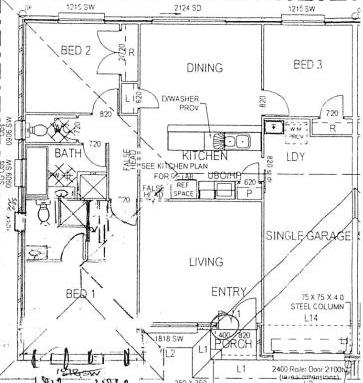
On appeal, Tamawood also successfully challenged Collier J’s conclusion that its copyright in “Stad 939 Conondale/Dunkeld”:

Stad 939 Conondale/Dunkeld

was not infringed by Mondo Duplex 1:

Mondo 1 Duplex with patio

Two points of interest here. First, the Full Court was unanimous in holding that Collier J had erred by ascertaining whether Mondo Duplex 1 sufficiently resembled Stad 939 Conondale/Dunkeld and then considering whether or not there had been copying. The question of copying needs to be resolved first although, in doing so, the degree of resemblance may lead to an inference of copying.

Secondly, for Jagot and Murphy JJ, the degree of resemblance, Mondo’s access to Tamawood’s plans and the significant difference between Mondo’s plans before that access and after all contributed to a conclusion of copying. Their Honour’s then applied Eagle Homes v Austec to find reproduction of a substantial part on the basis that the copyright work could still be seen in the accused plans. For Jagot and Murphy J the changes in the floor plan were minor. At [168]:

The footprints of the duplexes are identical but for the addition of the patio at the rear of the Mondo Duplex 1 plans. The internal and other external differences all result from two changes – swapping the position of bedroom 1 with bedroom 2 and swapping the position of bedroom 3 with the living/entry space. All changes appear consequential on these two basic changes in location. The changes, however, are minor, in the sense that the overall relationship between the internal spaces and the exterior remain the same. ….

Greenwood J dissented on this point at [89] – [90], considering that the layout and traffic flows, shapes and proportions and relationships of the rooms and other spaces were sufficiently different. His Honour considered that the common placement of Beds 1 and 2 and associated wet areas along the external walls of the duplex rather than the party wall was rational and for obvious reason.

Otherwise, the Full Court affirmed her Honour’s ruling at first instance.

Tamawood Limited v Habitare Developments Pty Ltd (Administrators Appointed) (Receivers and Managers Appointed) [2015] FCAFC 65


Project home appeals Read More »

Scroll to Top